Large-scale, Interactive Digital Signage
Moving away from MakingThings/Teleos hardware and going straight Flash 9 w/modified hardware. We include standard button interaction, drag+sweep gesture recognition, multi-touch and ability to scale to almost any window dimension w/o the need for depth or rear-view tracking…
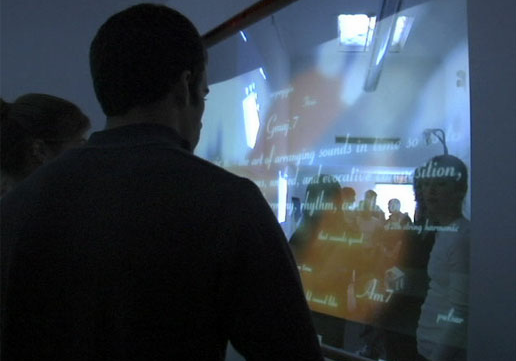
The Interactive Window is a back projected web-cam based system that can essentially turn any glass window (of any size) into a touch screen interface. This is a “non-contact interactive display” designed to be operated by intuitive human hand gesture. Gestures of press, push, scale and rotate are all programmable interactions of this technology. The system has the potential to be multi-touch (two handed gestures simultaneously recognized) and initial attempts at doing this have been successful.
Similar technologies are extremely expensive, have their own closed operating system and require multiple cameras. This platform is based on open source culture and is developed with Adobe Flash 3.0 development application - a widely available and popular development software, making the technology accessible to most (non-programming) designers and content developers. Additionally, this technology is based on projected light, so it easily scaleable and customizable in its size and proportions. Set up cost is extremely inexpensive by comparison, and thus, potentially very popular to the general public.
This updated “Interactive Mirror” presents a lower cost of entry into the interactive space and leverages open-source hardware/software to allow non-programmers and designers to develop digital spaces. We are not so much concerned with pixel-point precision and touch/pressure sensitivity… We are more interested in non-contact, gesture based interactive systems for information displays and exhibits that are easy to implement and open to designers.
CAM|Contemporary Art Museum
Contemporary Art Foundation, Raleigh http://cam.ncsu.edu/
Spring 2007 (ongoing)
Experimental research into alternative, interactive new media installations for education and entertainment. This form of large-scale digital exhibit, introduces designers to sensor data from external sources that utilize dynamic content creating a unique interactive experience that is both larger-than-life size and immersive in the experience. Utilizes Flash AS2, gesture recognition, infrared web camera tracking, Makingthings Teleos system and XML/RSS datasets.
This is experimental project into alternative, interactive new media installations for education and entertainment. “CAM,” no longer a “Contemporary Art Museum,” but keeping the acronym, seeks to get community involvement in artistic & creative events and hopes to infuse creativity into education in downtown Raleigh. It is not our intent with this project to turn designers into engineers. Our intention was based on the principle of having non-technologists work together with technology outside their expertise to produce artifacts that are informative, entertaining and promote an exchange of dialogue over design, technology and society. At the completion of this project typical design students in this research collaboration developed an understanding of technical design integration, a vocabulary of the field and a working knowledge on the application of technology in different disciplines. The initial large-scale, Interactive Mirror Installation, introduced designers to sensor data from external sources and utilized dynamic content creating a unique interactive experience.
The purpose of Design Expo Raleigh ’07 is to present great design to the public and to give designers, both professionals and students, a forum to display and discuss their work. A unique showcase of applied arts coming together as a whole, Design Expo Raleigh promotes broader awareness of many different design disciplines and creates an opportunity for local designers to network with each other, students, and the public.
This two-week event combined fund raising, project management, event coordination, marketing/promotion and website integration. Design Expo is the brain-child of Donald Corey (Other Edge) and was developed in conjunction with Michael Bustin (MeldUSA), Erick Mehlman (Cline Design), Amanda Robertson (iMediaGraphics), Jessie Schaefer (Signal Design) and a host of volunteers.
Developed FlicFlix, A Flash animation applet which integrates live video and real time green screen chromakey technology to fully immerse students, characters and props into the animation world.
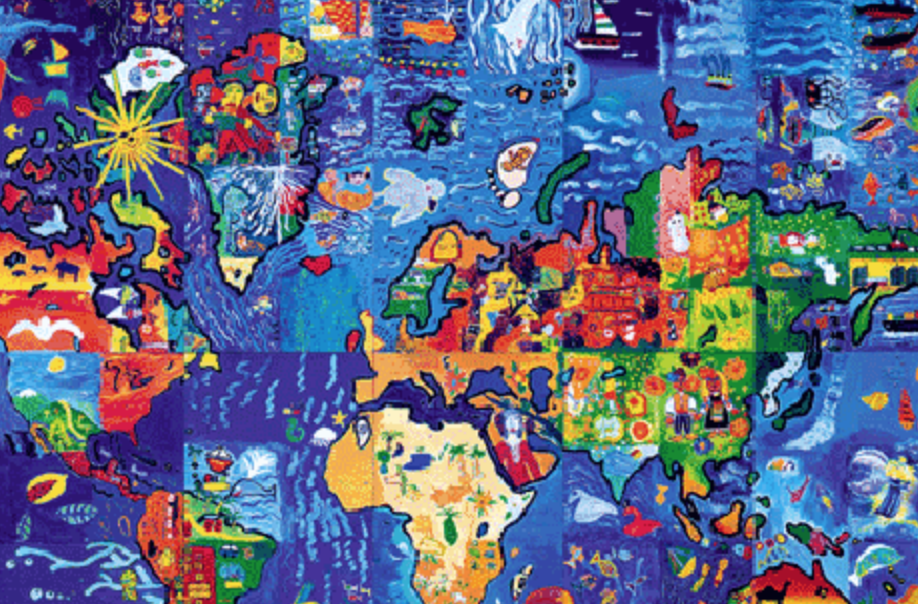
The most important international event for children, their teachers and parents in the world, the World Children’s Festival is hosted by the ICAF every four years, traditionally on the National Mall in Washington, DC. The World Festival integrates the arts, science, sport and technology to create a complete synesthetic experience — a total work of art that transforms the National Mall. Leading educators and experts come together to heal, inspire and unify children and peoples across the globe.
The Festival becomes a turning point in the participants’ lives, a touchstone to guide them in the future. The 2007 World Children’s Festival took place in Washington, DC on June 22-26. From June 23 to 25, the World Festival occupied from the 4th to the 7th Streets of the National Mall.
Developed a risk management analysis and a marketing strategy plan as part of complete case study for future expansion, financial analysis and image/visibility/positioning concerns. A collaborative effort between the NCSU, College of Management and Exploris Museum.
Recommendations include:
address the “Museum Experience” at consumer level and ‘living memory’ of the user
refine/redefine the museum retail and on-line stores
develop rich media applets to enhance the online web experience
integrate new technology to carry over the museum experience onto the web
leverage social networking to engage the audience and to allow museum attendees to share learning/experience online
expand food court to allow for Global Cafe themed venues
collaborate with similar museums and services to form a joint venture
increase interactive kiosk stations to allow students to share their experiences i.e. link up with a digital pen pal from a sister museum in France/UK
introduce large scale, digital signage tied to live web data and RSS feeds
create augmented spaces and exhibits that allowed museum attendees to be immersed in motion video and high definition audio from around the world
Exploris Museum is an innovative, interactive museum that explores the wonders and connections of our world, and fascinates both grown-ups and kids. The core exhibits demonstrate the connections between the people of the world through culture, global trade, the environment and communications. Through programs for adults and school children, cultural performances each weekend, forums in association with community organizations and traveling exhibits, Exploris endeavors to bring the world to downtown Raleigh. Exploris Museum also features an IMAX theater.
(Update - 9/15/07)
Work is underway on the transformation into Wake County’s new Kids Museum. Created by the merger of Exploris and Playspace, the new kids museum will open on September 29, at the current Exploris location, with brand new experiences and a brand new name.
Behavioral Targeting
Serving ads to anonymous Web site visitors based in the combination of pages they have visited.
The Challenge
Accipiter’s VIBE behavioral targeting product can recognize and target anonymous visitors that meet the traits a marketer has defined, but cannot predict what behavioral targets would be successful for a particular ad. The marketer receives only positive feedback (more clicks) or no feedback. There is no way for the marketer to know what behavioral targets would have been successful
Solution Platform
VIBE Ad Analytics is a proposed software product that uses powerful statistical algorithms based on game theory to predict what behavioral targets should correspond to an increase in the performance of advertisements. Identify behavioral traits that are statistically likely to be associated with a higher click rate. This will increase the value of online advertising for site publishers and their advertisers, leading to higher sales for Accipiter.
“With VIBE consulting, you will deliver the right ad to the right person at the right time and you will increase the click-through rate increasing your revenues or decreasing your costs”
Final Recommendations
The number of ways a visitor could get to clicking an ad is infinite; however, there may be some paths that are common to many visitors.
Reviewed sample model data sets and performed study models based on:
Pearson’s Correlation Equation – Computes basic statistical correlation.
ELO/Bayesian analysis – Assign relative scores in probabilistic events (such as game play)
Cluster Analysis – Graph data points and look for groupings
Bigrams (Game Theory) – Create single event pairs and correlate transitions between them
Revenue Projections, Pricing and Profitability
- Value Based Pricing, Cost-to-Server and Competitive Environment.
Web Interface, System Architecture and GUI Data Modeling
Service Launch and Market Entry Strategy: First-In Strategy and Slow Roll Out
Positioning Strategy, SWOT Analysis, Primary and Secondary Target Markets
Branding Strategy, Segmentation & Differentiation
Created an interactive website system as part of the Member’s Court marketing campaign for the USTA and American Express. System utilized a Flash/XML based website integrated with an ASP.net back-end.
Developed a XHTML front-end user interface for updating daily event information, weather forecasts, concert venues and end-of-day game player/match highlights.
Customized a digital visitor’s map and an electronic itinerary for fans to select local areas of interest, concerts and restaurant selections and ticket/game information for downloading/printing from Flash to PDF output.
Created Flash banner-ads and player/tournament micro websites for US Open fans and American Express card members.
“American Express has a long tradition of bringing unique experiences to the US Open and this year promises to be one of the best for American Express Cardmembers and fans alike,“ said Fred Jubitz, vice president, Charge Card Marketing, American Express.
United States Tennis Association (USTA) is the national governing body for the sport of tennis in this country. In addition to owning the U.S. Open and selecting members of the U.S. Davis Cup, Fed Cup, Olympic and Paralympic teams, the USTA administers a variety of programs nationwide for players of all ages and ability levels.
A not-for-profit organization, the association is divided into 17 Sections, of which the USTA Southern Section is the largest. The 168,000+ USTA members living in Alabama, Arkansas, Georgia, Kentucky, Louisiana, Mississippi, North Carolina, South Carolina, and Tennessee comprise the USTA Southern Section, and account for approximately 25% of the total USTA membership.